
How AI Background Removal Works in 2026
Behind every clean product cutout is a neural network trained to understand edges, depth, and subject boundaries. Here is how modern AI removal differs from old chroma-key methods.
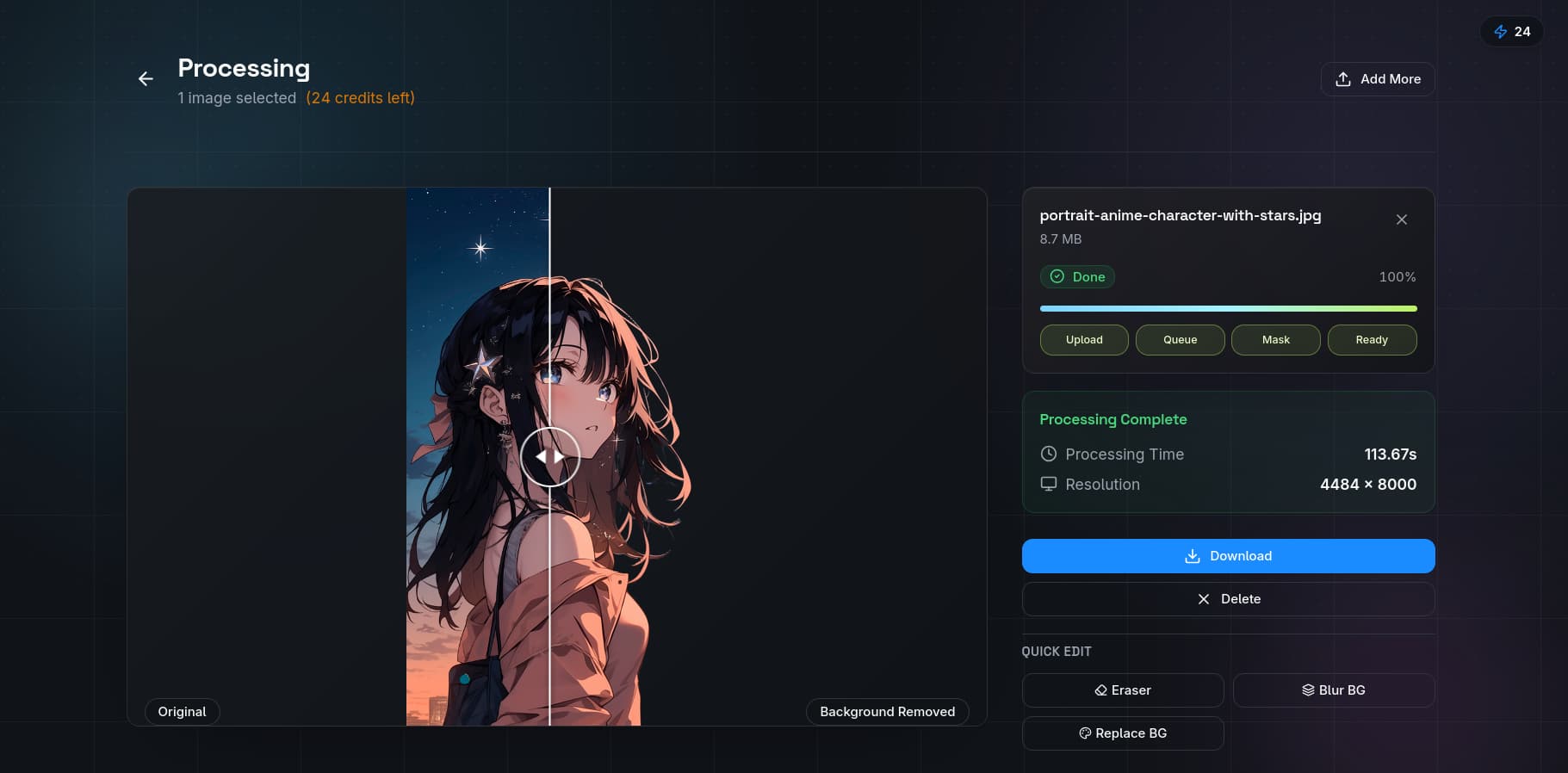
If you have ever used an online background remover, you have probably wondered how it separates a subject from its background with a single click. The short answer is deep learning — specifically a class of models called BiRefNet that have become the standard for high-quality matting in 2026.
What Is BiRefNet?
BiRefNet (Bilateral Reference Network) is a neural network architecture designed for image segmentation and background removal. Unlike older models that treated every pixel independently, BiRefNet uses a bilateral structure that processes both global context (the overall scene) and local detail (edges, hair strands, fine textures) simultaneously.
This dual-path design is what makes modern removal so much sharper than the tools from just a few years ago. The global path understands that this is a person standing in front of a wall, while the local path makes sure every strand of hair is preserved.
How the Pipeline Works
When you upload an image to QuickBG's background remover, the processing pipeline follows several stages:
1. Preprocessing — The image is resized to a standard resolution and normalized so the model sees consistent pixel values. Metadata like EXIF data is stripped at this stage for privacy.
2. Feature extraction — The model runs the image through a series of convolutional layers that identify edges, color clusters, textures, and depth cues. This is where the "understanding" happens: the model learns what is foreground and what is background without being told explicitly.
3. Refinement — BiRefNet's key innovation is a refinement stage that revisits ambiguous regions (hair, glass reflections, shadows) and applies a second pass of attention to clean up the boundary. This step is what eliminates the jagged edges that plagued early AI removers.
4. Matting — Instead of a hard binary mask, modern models output a soft alpha matte. Every pixel gets a transparency value between 0 and 1, which means semi-transparent objects like glass or veils are handled correctly.
5. Export — The final transparent PNG is assembled and returned. At QuickBG, this entire process takes between one and five seconds depending on image size and server load.
Why It Is Better Than Chroma Key
Traditional chroma key (green screen) requires a solid-colored background and controlled lighting. The subject cannot wear anything close to the key color, and shadows cause spill that must be corrected manually.
AI-based removal has none of these constraints. It works on any background — a cluttered room, a outdoor landscape, a patterned studio backdrop — and adapts to the specific image rather than relying on a color range. This makes it the go-to choice for e-commerce sellers who photograph products in varied environments.
Real-World Applications
The technology powers everything from product photo resizing workflows to background replacement for social media content. Sellers on Amazon and Etsy use it to create consistent listing images without building a studio. Designers pull subjects from imperfect source photos and composite them into clean layouts.
The best part is that you do not need to understand any of the underlying math. Upload an image, wait a few seconds, and download a ready-to-use cutout — the model does the rest.