
The Evolution of Background Removal: From Chroma Key to Deep Learning
Trace the fascinating journey of background removal technology from analog chroma key compositing to modern deep learning models like BiRefNet and MODNet.
Background removal has come a remarkably long way. What once required a $50,000 video mixer, a dedicated studio, and a carefully lit green screen can now be accomplished in milliseconds with a browser-based tool like our background remover. This article traces the evolution of background removal technology from its analog origins to the deep learning revolution that powers today's most accurate matting solutions.
The Chroma Key Era
Analog Beginnings
The first background removal technique was chroma key compositing, pioneered by Petro Vlahos in the 1960s. The concept was simple: shoot a subject in front of a uniformly colored backdrop, then electronically replace that color with a different background. Early systems like the Ultimatte used analog circuitry to detect the chroma key color and generate a control signal.
Key limitations of analog chroma key:
- Required a perfectly lit, evenly colored backdrop
- Struggled with motion blur and fine details like hair
- Could not handle transparent or semi-transparent objects
- Needed expensive specialized hardware
- Required significant studio space
| Era | Technology | Hardware Cost | Processing Time | Accuracy |
|---|---|---|---|---|
| 1960s-1980s | Analog chroma key | $50,000+ | Real-time | Low |
| 1990s | Digital chroma key | $10,000+ | Real-time | Medium |
| 2000s | Software chroma key | $500+ | Minutes | Medium |
| 2010s | ML-assisted matting | $0+ | Seconds | High |
| 2020s | Deep learning matting | $0+ | Milliseconds | Very High |
The Rise of Software-Based Removal
Photoshop and the Magic Wand
Adobe Photoshop introduced the Magic Wand tool in 1990, bringing background removal to the desktop. It worked by selecting contiguous pixels within a defined color range. While revolutionary for its time, it required significant manual refinement and struggled with complex edges.
Edge Detection and Matting
The late 1990s and early 2000s saw the development of more sophisticated matting algorithms:
- Bayesian Matting (2001): Used statistical models to estimate foreground and background colors
- Closed-Form Matting (2007): Solved the matting equation using a sparse linear system
- KNN Matting (2012): Used k-nearest neighbors for non-local matting
- Shared Matting (2010): Combined multiple sampling strategies
These algorithms were a significant step forward but still required a trimap — a user-provided segmentation that marked foreground, background, and unknown regions. This manual input was the biggest bottleneck.
The Deep Learning Revolution
The 2017 paper Deep Image Matting by Xu et al. marked a turning point. For the first time, a deep neural network could predict alpha mattes directly from a natural image and a trimap. The model used a two-stage architecture: a deep convolutional encoder-decoder for coarse prediction followed by a small refinement network.
Towards Trimap-Free Matting
By 2020, researchers began developing models that could produce high-quality mattes without trimaps:
MODNet (2020): A lightweight, real-time portrait matting model that operates without any auxiliary input.
U2Net (2020): A nested U-Net architecture that captures both fine details and global context.
BiRefNet (2023): The current state of the art, using bilateral reference networks for high-fidelity matting.
Comparison of Modern Approaches
| Model | Params | SAD | MSE | Trimap-Free | Real-Time |
|---|---|---|---|---|---|
| MODNet | 6.5M | 42.1 | 0.013 | Yes | Yes |
| U2Net | 44.0M | 38.8 | 0.009 | Yes | No |
| BiRefNet | 25.3M | 35.2 | 0.007 | Yes | Yes |
| Deep Matting | 14.2M | 39.7 | 0.011 | No | No |
Where We Are Today
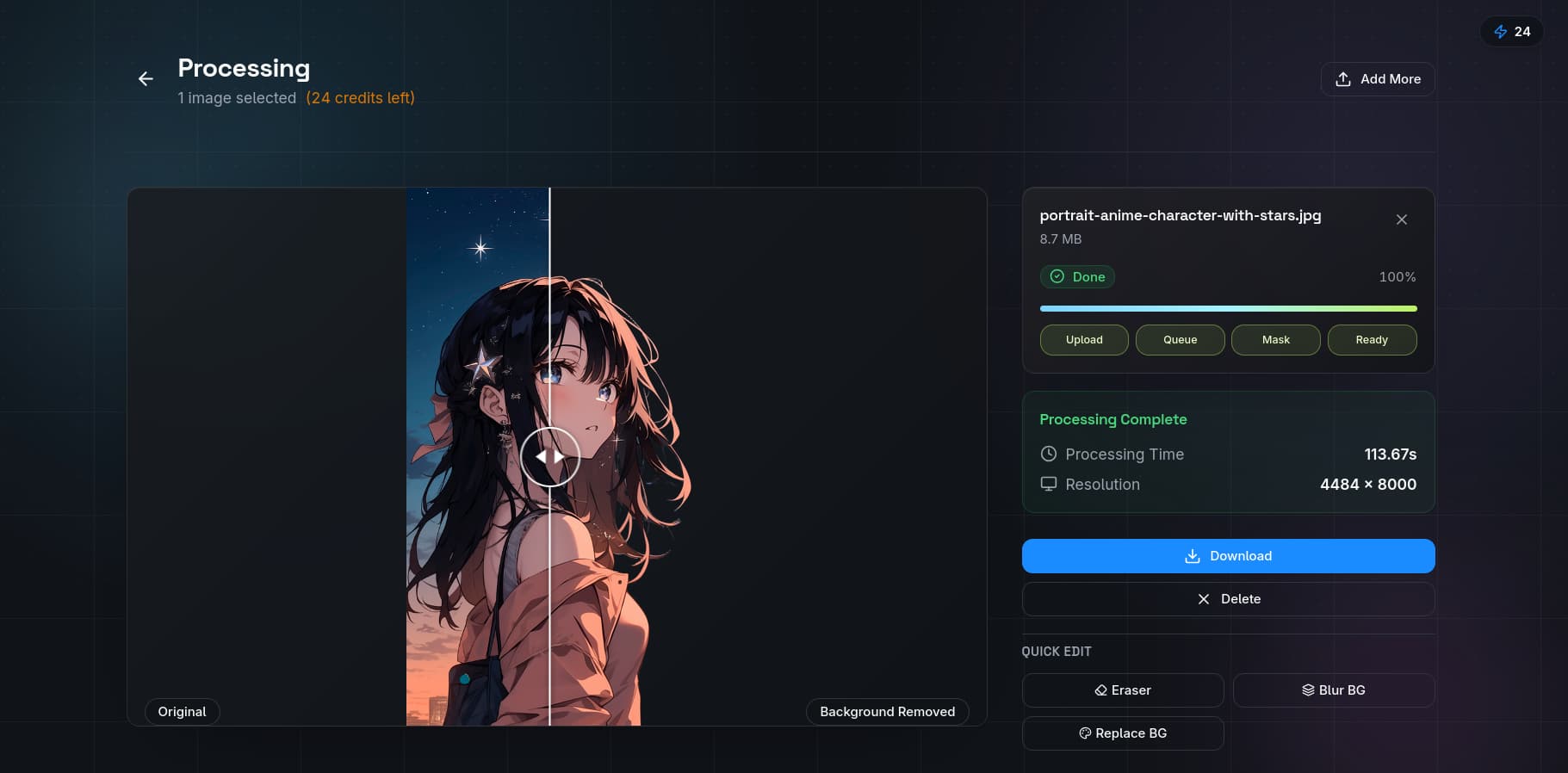
Modern background removal tools combine multiple deep learning models to handle different scenarios. Our background remover uses an ensemble of BiRefNet and MODNet, switching between them based on the input type. Portrait photos route through MODNet for speed, while complex subjects with fur or transparent objects use BiRefNet for maximum accuracy.
The crop tool, resize tool, and adjust tool all leverage the same underlying segmentation technology to deliver professional results in milliseconds.
The Future
Looking ahead, the next breakthroughs in background removal will likely come from:
- Video matting: Real-time per-frame matting for video streams
- 3D-aware matting: Using depth information for more accurate edges
- Interactive refinement: Allowing users to correct mistakes with minimal clicks
- On-device processing: Running sophisticated models on mobile devices
Visit our tools page to explore all available options, or check the FAQ for technical details. Learn more about our mission on the about page.
From analog chroma key mixers costing tens of thousands of dollars to free browser-based AI tools, background removal technology has undergone a remarkable transformation. The shift from hardware-dependent chroma key to software-based matting to deep learning has democratized access to professional-quality image editing. Today, anyone with a web browser can achieve results that would have required a professional studio just a decade ago.